
This guide breaks down what multi-state registration actually costs: initial filing fees, annual report requirements, and the total cost of ownership (TCO) for maintaining good standing across all 50 states.
What Is Secretary of State Registration?
When your company operates in a state other than where it was formed, you must "foreign qualify" by registering with that state's Secretary of State. This registration:
- Authorizes your company to legally conduct business in that state
- Establishes your registered agent for service of process
- Creates annual reporting and fee obligations
- Ensures you maintain "good standing" status required for contracts, licensing, and banking relationships
For LLCs pursuing state licenses (like money transmitter licenses), SoS registration is a prerequisite: you can't apply for an MTL in a state where you're not registered to do business.
Related: Secretary of State Registration Guide for Fintechs | Quick Reference
Why Multi-State Registration Adds Up Fast
Most founders underestimate the cumulative cost of multi-state compliance. While individual state fees seem modest ($100-$400 typically), they multiply quickly:
- 50 states = 50 separate registrations
- 50 different annual report deadlines
- 50 registered agent relationships to maintain
- Varying renewal cycles (annual, biennial, or even decennial)
Miss a deadline and you risk losing good standing, which can delay license applications, void contracts, and create legal liability for operating without authorization.
Part 1: Initial and Annual Registration Costs by State
Registration fees vary significantly by state. Here's what you'll pay for initial foreign qualification for LLCs, plus ongoing annual report costs and key deadlines.
State-by-State Registration Breakdown
Part 2: Total Cost of Ownership for Multi-State Registration
Annual Compliance Costs Nationwide
Costs vary based on registered agent provider and state-specific factors.
TCO Factors to Consider
Biennial and Odd-Year Filings Several states only require reports every other year (Alaska, DC, Indiana, Iowa, Nebraska, New York, Ohio). This reduces costs in off-years but requires careful calendar management.
Registered Agent Costs You need a registered agent in every state: someone authorized to receive legal documents on your behalf. Costs typically run $100-$200 per state annually, adding $5,000-$10,000 to your nationwide compliance budget.
Reinstatement Penalties Lapsing on annual reports can result in administrative dissolution or revocation of your authority to do business. Reinstatement fees, penalties, and back filings can cost $500-$2,000+ per state.
Compliance Management Overhead With 50 different deadlines spread throughout the year, tracking and filing on time requires dedicated attention. Many companies underestimate the administrative burden until they miss a deadline.
Related -> How Much do MTLs Cost
Critical Deadlines: When Annual Reports Are Due
Managing 50 different due dates is one of the biggest challenges of multi-state compliance. Here's how deadlines cluster:
Fixed Calendar Deadlines
Anniversary-Based Deadlines
Fiscal Year-Based Deadlines
Processing Times: How Long Registration Takes
If you're on a tight timeline—say, applying for money transmitter licenses with a launch deadline—registration processing times matter.
Fastest States (1-2 Days)
Alaska, Colorado, Indiana, Iowa, Kentucky, Massachusetts, Mississippi, Nevada, New Jersey, Oregon, Puerto Rico, South Dakota, Wisconsin, Alabama, Louisiana, Minnesota, Oklahoma, South Carolina, Texas, Washington
Moderate Processing (3-15 Days)
Connecticut, Vermont, Rhode Island, Tennessee, Arkansas, Kansas, New York, Montana, Delaware, Ohio, Pennsylvania, Georgia, North Carolina, Hawaii, Utah, New Hampshire, Wyoming, Idaho, DC
Slowest States (15-45 Days)
Maryland, Nebraska, West Virginia, Arizona, Virginia, California, New Mexico, North Dakota, Maine, Illinois
Many states offer expedited processing for additional fees.
Related -> MTL Timeline Guide: Fast-Track Your Money Transmitter Licenses
Strategic Considerations for Multi-State Registration
Registration Is a Prerequisite for Licensing
If you're pursuing money transmitter licenses, securities registrations, or other state licenses, you must be registered with the Secretary of State first. Plan your SoS filings to align with your licensing timeline.
Good Standing Matters
Banks, enterprise customers, and investors often require certificates of good standing. A single lapsed registration can delay deals and damage credibility. Build compliance monitoring into your operations.
States Without Annual Reports
Three states have no annual report requirement for most business types: Missouri, New Mexico, and South Carolina (for non-S/C corps). Texas has no franchise tax for businesses under $1.18M in revenue. These reduce ongoing costs but still require initial registration.
Lowest-Cost States
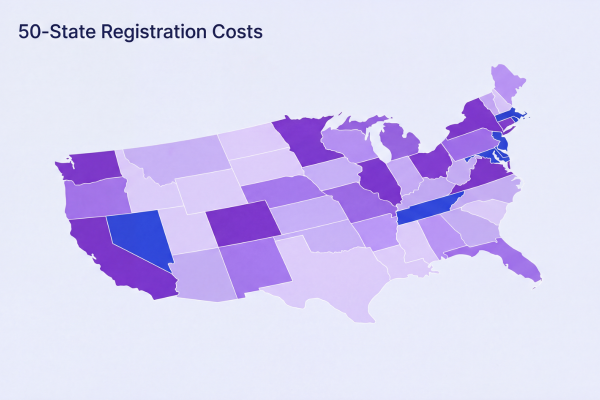
Pennsylvania stands out with only a $70 decennial (every 10 years) filing—the lowest ongoing cost in the nation. Minnesota, Mississippi, and Idaho also have minimal annual fees at $100.
Highest-Cost States
Massachusetts ($620), Nevada ($450), Delaware ($400 franchise tax), DC ($400 biennial), and Tennessee ($300) have the highest annual fees.
Stay Compliant Across All 50 States
Multi-state registration is the foundation of legitimate nationwide operations. While individual fees seem small, the cumulative cost and complexity of managing 50 different jurisdictions adds up quickly.
The companies that succeed treat compliance as an operational priority—tracking deadlines proactively, maintaining good standing consistently, and building registration timelines into their growth plans.
Ready to streamline your multi-state compliance? Get a demo of Brico to learn how we can help you manage registrations efficiently and never miss a deadline.
Disclaimer: This article is for informational purposes only and does not constitute legal, financial, or regulatory advice. Brico is not a law firm and does not provide legal counsel. Licensing requirements vary by state and depend on your specific business model and circumstances. You should consult with qualified legal counsel before making any licensing decisions or taking action based on this content.