Streamline your fintech compliance with this quick reference guide to Secretary of State registrations, covering formation, foreign qualifications, fees, and ongoing requirements across states. It's essential for money transmitter licensing preparation.
The Fintech Compliance Stack
| Layer | What It Is | Who Requires It | Why It Matters |
|---|---|---|---|
| 1. SOS Registration | State business entity formation | Secretary of State (each state) | Creates your legal entity; prerequisite for everything else |
| 2. MSB Registration | Federal money services business classification | FinCEN (U.S. Treasury) | Establishes federal AML compliance obligations |
| 3. MTL Licensing* | State money transmitter authorization | State financial regulators | Permits you to actually transmit money |
*Check state licensing requirements to see if exemptions apply for certain types of money transmission activity.
⚠️ Key Point: You need all three layers. SOS registration creates your entity. MSB registration classifies you federally. MTLs authorize your operations. Missing any layer means you can't legally operate.
Domestic vs. Foreign Registration
| Aspect | Domestic Registration | Foreign Registration |
|---|---|---|
| What it is | Forming your entity in a state | Registering an existing entity to operate in another state |
| When needed | Once (in your formation state) | In every additional state where you do business |
| Documents filed | Articles of Organization/Incorporation | Certificate of Authority / Foreign Registration |
| Typical fee | $50 – $500 | $50 – $750 |
For fintech companies: If you're pursuing MTLs in 48 states, you need 1 domestic registration + 47 foreign registrations.
Formation State Comparison
| Factor | Delaware | Wyoming | Home State |
|---|---|---|---|
| Best for | Venture-backed startups | Crypto/blockchain, bootstrapped | Local operations, simplicity |
| Legal framework | Most established; Court of Chancery | Favorable digital asset laws | Varies by state |
| Investor familiarity | High (default expectation) | Growing | Depends on state |
| Formation fee | $90 (LLC) / $89+ (Corp) | $100 (LLC) / $100 (Corp) | Varies |
| Annual fees | $300 (LLC) / $225+ (Corp) | $60 (LLC) / $60 (Corp) | Varies |
| Privacy | Moderate | Strong | Varies |
| Still need foreign registration? | Yes, in every operating state | Yes, in every operating state | Yes, if operating in other states |
Bottom line: Formation state affects taxes, legal flexibility, and investor perception—but doesn't reduce your multi-state registration burden.
State Registration Fees (Sample)
Fees and requirements differ by entity type and change over time; always verify on each state’s Secretary of State site before relying on these numbers.
| State | LLC Formation | Foreign LLC | Corp Formation | Foreign Corp | Annual Report |
|---|---|---|---|---|---|
| California | $70 | $70 | $100 | $100 | $20 – $800 |
| Delaware | $90 | $200 | $89+ | $245+ | $300+ |
| Florida | $125 | $125 | $70 | $70 | $138.75 |
| New York | $200 | $250 | $125 | $225 | $9 |
| Texas | $300 | $750 | $300 | $750 | $0 (franchise tax instead) |
| Wyoming | $100 | $100 | $100 | $100 | $60 |
Multi-state budget estimate:
- Initial SOS filings (all states): $10,000 – $20,000
- Annual reports (all states): $5,000 – $15,000/year
- Registered agents (all states): $5,000 – $15,000/year
Ongoing Compliance Requirements
| Requirement | Frequency | What's Required | Consequence of Missing |
|---|---|---|---|
| Annual reports | Annual or biennial (varies by state) | Confirm business name, address, officers, registered agent | Late fees → Loss of good standing → Administrative dissolution |
| Registered agent | Continuous | Maintain agent with physical address in each state | Missed legal service → Default judgments; SOS rejection of filings |
| Information updates | As changes occur | File amendments for name, address, officer, or ownership changes | Outdated records; compliance issues during examinations |
| Franchise/entity taxes | Annual (some states) | Pay required state taxes (CA, DE, TX, others) | Tax liens; loss of good standing; inability to get certificates |
The Dependency Chain: Why SOS Compliance Affects Licensing
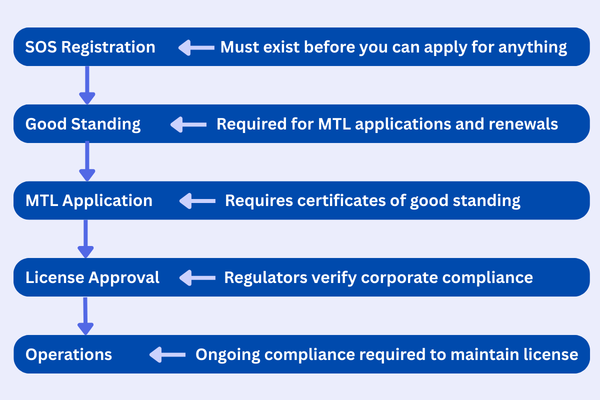
If any link breaks, everything downstream stops.
Documents Required for MTL Applications
FAQs
Why is SOS registration prerequisite for MTLs?
Regulators require proof of entity formation, good standing certificates (valid 30–90 days), and active registered agents before reviewing MTL apps. Without it, you can't legally apply or operate.
Ongoing SOS compliance requirements?
Maintain annual/biennial reports, a physical registered agent per state, timely updates to business info, and good standing certificates. Lapses lead to late fees, dissolution, or rejected MTL applications.
What are typical SOS registration fees?
Fees vary: Delaware LLC formation is $90 with $300 annuals, Wyoming $100/$60, California $70 formation but up to $800 annuals. Multi-state fintechs should budget $10,000–$20,000 initially and $5,000–$15,000 yearly for filings and agents across all states.
Best states for fintech entity formation?
Delaware suits venture-backed startups due to its established legal framework and investor familiarity, while Wyoming favors crypto and bootstrapped firms with favorable digital asset laws and low fees. The choice impacts taxes and flexibility but requires foreign registration everywhere else.
Domestic vs. foreign SOS registration?
Domestic registration forms your entity once in your chosen home state like Delaware or Wyoming, while foreign registration qualifies that entity to do business in additional states. Fintechs pursuing MTLs in multiple states typically need one domestic and up to 47 foreign registrations.
What is Secretary of State (SOS) registration?
SOS registration creates your legal business entity in a state, serving as the foundation for all compliance activities including money transmitter licenses (MTLs). It's required domestically in your formation state and as foreign registration in every state where you operate or pursue licensing.

Schedule a Demo
Schedule a demo to see how Brico can streamline your licensing process.