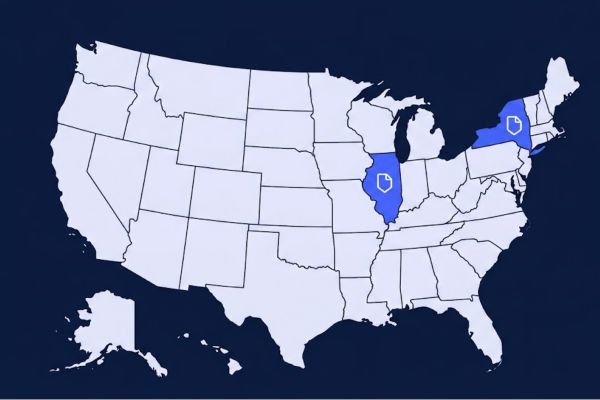
Franchise tax (also called privilege tax, capital stock tax, or net worth tax depending on the state) is one of the most confusing compliance obligations for multi-state fintechs. Unlike income tax based on profits, franchise tax is typically a fee for the privilege of doing business in a state—regardless of whether you're profitable.
This guide breaks down franchise tax requirements specifically for fintech companies operating across multiple states, including which states impose franchise taxes, how each state calculates them, when they're due, and how to budget for multi-state compliance.
What Is Franchise Tax?
Franchise tax is a state-level tax charged to businesses for the right to operate within that state's borders. Despite the name, it's not limited to franchises—it applies to corporations, LLCs, limited partnerships, and other registered entities.
Key Characteristics
Not based on profitability: You owe franchise tax even if your business operates at a loss or generates no revenue during the year.
Separate from income tax: Most states charge both franchise tax and corporate income tax. They're separate obligations with different calculations and deadlines.
State-specific calculations: Each state uses its own formula—some charge flat fees, others base calculations on net worth, capital stock, gross receipts, or complex margin formulas.
Annual obligation: Like annual reports, franchise taxes recur every year for as long as you're registered in the state.
Which States Charge Franchise Tax?
As of 2025, approximately 16 states impose some form of franchise tax, though terminology varies. Here's the complete list:
States With Traditional Franchise Taxes
- Alabama – Business Privilege Tax (based on net worth)
- Arkansas – Franchise Tax (based onentity type)
- California – Franchise Tax ($800 minimum for LLCs, calculated for corporations)
- Delaware – Franchise Tax (authorized shares or assumed par value method; LLCs have a flat $300 fee)
- Georgia – Net Worth Tax (based on company net worth)
- Illinois – Franchise Tax (based on paid-in capital, frozen at partial exemption)
- Mississippi – Franchise Tax (phasing out, complete elimination by 2028)
- New Mexico – Franchise Tax
- New York – Franchise Tax under Article 9-A (graduated rates based on allocated net income)
- North Carolina – Franchise Tax (based on capital stock, par value, or net worth)
- Tennessee – Franchise/Excise Tax (based on net worth)
- Texas – Franchise Tax/Margin Tax (based on margin calculation)
- Washington, D.C. – Franchise Tax (8.25% of taxable income)
States That Eliminated Franchise Tax
- Oklahoma – Eliminated franchise tax in 2024
- West Virginia – Phased out by 2015
- Rhode Island – Phased out by 2015
- Pennsylvania – Phased out by 2016
- Kansas – Phased out by 2011
- Louisiana – Phased out as of January 1, 2026
States Without Franchise Tax
The remaining 37+ states either never imposed franchise tax or have eliminated it. However, these states still collect revenue through corporate income tax, gross receipts taxes, or other mechanisms such as “privilege-style” taxes under different names.
How Franchise Tax Is Calculated: State-by-State Breakdown
Delaware: The Dual-Method System
Delaware corporations can choose between two calculation methods—always use whichever results in lower tax.
Authorized Shares Method:
- $175 minimum for ≤5,000 shares
- $250 for 5,001-10,000 shares
- +$85 per additional 10,000 shares
- Maximum: $200,000
Example: Company with 10 million authorized shares = $85,165 using this method
Assumed Par Value Capital Method (Preferred for Startups):
- Calculate assumed par value: (Total gross assets / Issued shares)
- Multiply by authorized shares = Assumed par value capital
- Tax = $400 per $1M of assumed par value capital
- Minimum: $400
- Maximum: $200,000
Example: Company with $100,000 gross assets, 5M issued shares, 10M authorized shares:
- Assumed par value: $100,000 / 5M = $0.02
- Assumed par value capital: $0.02 × 10M = $200,000
- Tax: ($200,000 / $1M) × $400 = $80
Delaware LLCs: Flat $300 annual tax
When due: March 1 annually
California: The Flat Minimum
Corporations: Minimum $800 franchise tax, regardless of income or activity LLCs: $800 annual LLC tax (separate from franchise tax)
California's franchise tax applies even to inactive entities—you must pay the $800 even if your company did nothing all year.
When due: 15th day of 4th month after start of tax year (typically April 15)
Texas: The Margin Tax
Texas uses a complex "margin" calculation instead of traditional franchise tax.
Threshold: No tax due if revenue is under $2,470,000 (as of 2025)
Tax rate:
- 0.375% for most businesses
- 0.75% for certain entities
Margin calculation (use the lowest):
- 70% of total revenue
- Total revenue minus cost of goods sold
- Total revenue minus compensation
- Total revenue minus $1 million
Example: Company with $5M revenue, $2M in compensation:
- Option 1: 70% × $5M = $3.5M
- Option 2: $5M - $2M = $3M (lower)
- Tax: $3M × 0.375% = $11,250
When due: May 15 annually
New York: Article 9-A Franchise Tax
New York's franchise tax is complex, based on allocated net income with graduated rates.
Tax rates (2025):
- 4.875% (qualified manufacturers, including qualified emerging technology companies)
- 6.5% (most businesses)
- 7.25% (certain businesses)
Minimum tax: Based on New York receipts, ranging from $25 to $200,000
New York also requires estimated quarterly tax payments if you reasonably expect to owe more than $1,000.
When due: 15th day of 3rd month after tax year ends (typically March 15)
Georgia: Net Worth Tax
Georgia calculates franchise tax based on your company's net worth.
Calculation: Net worth × Apportionment factor
When due: April 15 (filed with corporate income tax)
North Carolina: Franchise Tax
Calculation: $1.50 per $1,000 of the corporation's tax base, with a maximum of $500 for the first $1,000,000 of its tax base and is applied as set forth in the law. The minimum franchise tax is $200.
When due: 15th day of 3rd month after fiscal year end
Tennessee: Franchise/Excise Tax
Franchise Tax: $0.25 per $100 of net worth (minimum $100) Excise Tax: 6.5% of net earnings
Both are due together and function as Tennessee's corporate tax system.
When due: 15th day of 4th month after close of fiscal year
Illinois: Franchise Tax
Calculation: Based on paid-in capital - multiply your total paid-in capital by .0015 (.15%) to get your franchise tax due Status: Partially phased out; exemption frozen at $1,000
When due: Filed annually by accountant with Secretary of State
Arkansas: Franchise Tax
Calculation: Based on capital stock employed in the state - minimum tax is set at $150 Rate: Varies by capital stock amount
When due: Filed with state corporate income tax
Alabama: Business Privilege Tax
Calculation: Rates range from $0.25 to $1.75 for each $1,000 of net worth Minimum: $50 (reduced from $100, eliminated after 2023 except for cannabis businesses)
When due: Filed with corporate income tax return
Nevada: Commerce Tax
Nevada doesn't call it "franchise tax," but the Commerce Tax functions similarly.
Threshold: Only applies to businesses with Nevada gross revenue exceeding $4 million Rate: Tiered rates from 0.051% to 0.331% depending on industry
When due: July 31 annually
New Mexico: Franchise Tax
Calculation: Based on capital employed in state
When due: Varies by entity type
Multi-State Franchise Tax: Total Cost Analysis
For fintech companies pursuing nationwide money transmitter licenses, franchise tax obligations stack up across multiple jurisdictions.
Scenario: Fintech with 50-State MTL Coverage
Total annual franchise tax burden (50-state fintech): $4,000-$35,000+
The wide range depends on your company's financials (gross assets, net worth, authorized shares), revenue levels, and capital structure.
Cost Context
For context, compare franchise taxes to other multi-state costs:
- Franchise taxes: $4,000-$35,000
- Annual reports (50 states): $6,000-$10,000
- Registered agents (50 states): $5,000-$10,000
- Total annual corporate compliance: $15,000-$55,000
Franchise tax represents 25-60% of total ongoing corporate compliance costs.
Related: How Much Do MTLs Cost?
Franchise Tax Deadlines by State
Missing franchise tax deadlines triggers penalties, interest, and potential loss of good standing. Here's the master calendar:
Franchise Tax vs. Income Tax: Key Differences
Many founders confuse franchise tax with corporate income tax. They're separate obligations:
Most states with franchise taxes also have corporate income taxes—you pay both.
Penalties for Late Franchise Tax Payment
Late franchise tax filing triggers multiple consequences:
Financial Penalties
Delaware: $200 penalty + 1.5% monthly interest on unpaid balance
California: 5% penalty for late filing, up to 25% maximum
Texas: 5% penalty for 1-30 days late, escalating for longer delays + $50 minimum penalty per report
New York: Penalties and interest on unpaid tax
Loss of Good Standing
Unpaid franchise tax causes your business to fall out of good standing with the state, which triggers inability to obtain certificates of good standing, potential MTL license suspension or revocation, inability to defend lawsuits or enforce contracts, and administrative dissolution if unpaid for extended period (typically 3 years).
Related: Certificate of Good Standing: What It Is and How to Get One
Regulatory Consequences for Licensed Fintechs
State banking regulators monitor licensees' corporate good standing. Franchise tax-related compliance failures appear in examination findings, may trigger supervisory actions, and demonstrate inadequate compliance management systems.
Strategies to Minimize Franchise Tax
For Delaware Corporations
Always use the Assumed Par Value Method for calculating franchise tax. The default method (Authorized Shares) often produces bills 100x higher than the optimized method.
Optimize your share structure: Keep issued shares as a meaningful percentage of authorized shares to reduce assumed par value capital.
Consider Delaware LLC instead of C-Corp if VC funding isn't imminent—flat $300/year vs. $400-$800+.
For Multi-State Fintechs
Strategic foreign qualification: Only foreign qualify in states where you're actually conducting business or seeking licenses. Don't file prophylactically in states you might someday enter.
Monitor revenue thresholds: Texas has no franchise tax for companies under $2.47M revenue. Nevada's Commerce Tax only applies above $4M. Stay aware of when you cross these thresholds.
Leverage entity structure: Some entity types are exempt from franchise tax in certain states. Consult with tax advisors about optimal structure.
For All Businesses
File on time, every time: Late penalties often exceed the underlying tax. Set up compliance calendars and automated reminders.
Budget proactively: Factor franchise taxes into your financial model from day one. They're predictable, recurring costs.
Use accounting professionals: For states with complex calculations (Texas, New York), professional preparation ensures accuracy and may identify legitimate deductions.
Common Franchise Tax Mistakes
Mistake #1: Assuming "No Revenue = No Tax"
Franchise tax is due regardless of profitability or activity. Even dormant companies owe franchise tax in most states.
Mistake #2: Using Delaware's Default Calculation
Delaware's initial bill uses the Authorized Shares Method, which produces astronomical amounts for companies with millions of authorized shares. You must manually recalculate using the Assumed Par Value Method when filing.
Mistake #3: Ignoring Franchise Tax Because "We're Not a Franchise"
The name is misleading. Franchise tax applies to all registered businesses in applicable states, not just franchises.
Mistake #4: Missing Estimated Tax Requirements
Some states (New York, California) require quarterly estimated franchise tax payments if you expect to owe significant amounts. Missing estimated payments triggers penalties even if your annual filing is timely.
Mistake #5: Treating Franchise Tax Like Income Tax
You can't avoid franchise tax by operating at a loss. It's a privilege tax for doing business, not a profit tax.
Franchise Tax and MTL Applications
State regulators evaluate your corporate compliance as part of MTL applications and examinations.
Initial License Applications
Most states require you to provide certificates of good standing from your formation state and every state where you're foreign qualified. If you owe franchise taxes, you can't obtain these certificates, and your application cannot proceed.
Annual Renewals
Many states require updated certificates of good standing with renewal filings. Franchise tax arrears prevent renewal approval.
Examinations
Examiners verify corporate good standing status during routine examinations. Franchise tax delinquencies appear in examination findings and may trigger supervisory actions.
Building Franchise Tax into Your Compliance Routine
Create a Franchise Tax Calendar
Track every state's deadline in a master calendar with 60-day advance warnings, 30-day reminders, and 7-day final alerts before deadline.
Designate Responsibility
Assign specific team members to handle franchise tax in each state where you're registered—accountant, CFO, compliance officer, or outsourced service.
Integrate with Annual Report Filing
Many states combine franchise tax and annual reports. File them together to streamline compliance.
Budget Quarterly
Allocate budget quarterly for franchise tax obligations. Don't let annual bills catch you unprepared.
Document Everything
Maintain organized records of franchise tax confirmations, payment receipts, calculations, and good standing certificates.
When to Outsource Franchise Tax Compliance
DIY Makes Sense For:
- Single-state operations
- States with simple flat fees (Delaware LLC, California minimum)
- Founders with accounting background
- Startups with minimal revenue
Hire Professionals For:
- Complex calculation states (Texas margin tax, New York Article 9-A)
- Multi-state operations (10+ states)
- Businesses with significant revenue or assets
- When franchise tax exceeds $5,000 annually
Professional preparation typically costs $200-$1,000 per state depending on complexity—often worth it to ensure accuracy and optimize calculations.
Franchise Tax Trends: What's Changing
States Eliminating Franchise Tax
The trend clearly favors elimination. Recent changes include Oklahoma eliminated in 2024, Louisiana eliminated in 2025, and Mississippi phasing out (complete by 2028).
States recognize franchise taxes are economically distortive—they disincentivize capital accumulation and penalize growth.
States Increasing Thresholds
Texas raised its no-tax-due threshold from ~$1M to $2.47M, exempting many small businesses.
States Reinstating After Elimination
New York temporarily reinstated capital stock tax (2021-2024) due to COVID-related budget concerns. Illinois froze its phaseout plans. Watch for revenue-pressured states reconsidering eliminations.
Build Franchise Tax into Your Growth Strategy
Franchise tax is one of those unsexy compliance obligations that quietly accumulates as you expand. A Delaware corporation paying $400 annually doesn't seem significant—until you're foreign qualified in 15 states with franchise taxes and suddenly your annual bill is $8,000+.
Smart fintech founders treat franchise tax as a predictable operating expense, factor it into financial models from day one, build systems to track deadlines across all registered states, and engage professionals for complex calculations.
Ready to streamline your multi-state compliance? Contact Brico to learn how we help fintech companies manage MTL licensing obligations across all 50 states.
Disclaimer: This article is for informational purposes only and does not constitute legal, financial, or regulatory advice. Brico is not a law firm and does not provide legal counsel. Licensing requirements vary by state and depend on your specific business model and circumstances. You should consult with qualified legal counsel before making any licensing decisions or taking action based on this content.