
Many fintechs spend months getting licensed to originate consumer loans and then discover, during a secondary market transaction, a regulatory examination, or a state inquiry, that the servicing activity they have been doing since launch required a separate license. The origination license got the attention. The servicer license did not.
That gap in licensing is a real compliance exposure risk. In a growing number of states, the act of collecting payments, managing delinquent accounts, processing payoffs, and communicating with borrowers about loan status is a licensed activity, independent of whoever made the loan. If your company services consumer loans it did not originate (acts as a sub-servicer), manages servicing for a bank partner, or purchased a performing consumer loan portfolio, a lender license may not be enough.
This guide explains who needs a consumer loan servicer license, how servicing licensing differs from origination licensing, which states require separate authorization for non-mortgage consumer loan servicers, and what happens to the compliance picture when a bank partnership is in the middle.
What is a consumer loan servicer license?
Loan servicing means managing the post-origination relationship between borrower and lender. That covers collecting scheduled payments, applying payments to principal and interest, managing payment histories, handling customer inquiries, processing payoffs and early terminations, managing forbearances or loan modifications, and furnishing accurate data to credit bureaus.
A license that allows an entity to service a consumer loan, authorizes a non-bank entity to perform functions, defined under the state statutes as servicing, on consumer loans, specifically loans made to individuals for personal, family, or household purposes. It can be a separate and distinct authorization from the license that governs making the loan in the first place.
Most states require licensing for nonbank loan servicers, and these statutes often include requirements that apply when ownership structures or servicing relationships shift. The specific license name, the regulator, and the threshold for when servicing activity triggers the requirement vary considerably by state.
This guide covers non-mortgage consumer loan servicing specifically. Mortgage servicer licensing is a separate regulatory track governed by different statutes, different NMLS workflows, and in most states, different agencies. If you service residential mortgage loans, the mortgage servicer licensing analysis is distinct from what is covered here.
Servicer license vs. lender license: why the distinction matters
The most common assumption fintechs make is that a consumer lender license covers the full credit lifecycle, including servicing. That assumption is correct in many states for loans you originated yourself. It is frequently wrong in three situations that are increasingly common in fintech lending.
Servicing loans you did not originate. When a fintech services loans originated by a bank partner, a prior lender, or a portfolio seller, the fintech's own origination license does not cover that activity. If a servicer is operating as a third party vendor (aka a Sub-Servicer), several states treat this third-party servicing activity as a separately licensed function.
Bank partnership models. In the typical embedded lending model, a chartered bank originates the loans while the fintech handles marketing, underwriting, and all borrower-facing operations including servicing. A bank's federal charter doesn't automatically preempt state servicer licensing requirements that may apply to the fintech's own activities. Whether a servicing license is required depends on the applicable state law, how the servicing arrangement is structured, and whether an exemption applies, not on how the loan documents characterize the bank's role.
Portfolio acquisitions. A company that purchases a performing consumer loan portfolio acquires the right to receive payments from borrowers. In a number of states, holding that right and directing payments makes the purchaser a servicer requiring a license, even if a sub-servicer is doing the actual payment processing.
States may require licenses to make unsecured consumer loans in addition to, or separately from, licenses to arrange/broker loans, service loans, engage in debt collection activities, or take assignment of loans. Not every state requires a license for every type of activity. The question for each state is whether your specific activities trigger a separate authorization.
Three servicing structures and how state licensing applies
Structure 1: You originate and service your own loans
In most states, your consumer lender license covers the full origination-to-payoff lifecycle for loans you made yourself. This is the cleanest servicing structure from a licensing standpoint.
The exceptions are important, though. California is the clearest example. The California Finance Lender License (CFL), administered by the DFPI, restricts what a CFL licensee can service: CFL licensees can only service loans they made or loans they made and then sold to an institutional investor. A CFL licensee cannot service third-party loans (i.e. cannot service consumer loans it does not own the servicing right to or cannot act as a sub-servicer). That activity requires either a separate license or a different license type entirely. Fintechs operating in California under the CFL who expand into servicing loans for bank partners or purchasing servicing rights will find they are outside the scope of their existing license.
For fintechs originating and servicing their own loans in most other states, the primary licensing focus should be confirming that the state's consumer lender license statute explicitly covers servicing activity, not just making loans, and that there is no separate servicer authorization requirement triggered by portfolio size or loan type.
Structure 2: You service loans originated by a bank partner
This is where the most compliance exposure sits in 2026, and the regulatory environment has been moving against the "bank partner exemption covers servicing too" position for several years. Generally speaking, if the entity is a free standing entity and engaging in activities that constitute servicing activities, the entity will also be required to be licensed as it is fitting the definition of a third party vendor, even if it is a “bank partner.”
For example; Connecticut amended its consumer lending statute to require licensing for any person acting as an agent, service provider, or in another capacity for an insured depository institution if they hold the predominant economic interest in the loan, market or facilitate the loan and hold a right of first refusal to purchase receivables, or if the totality of circumstances indicates the structure is designed to evade licensing requirements. A fintech that markets bank loans to Connecticut consumers and then services those loans for the bank's benefit is squarely within the statute's reach.
Nebraska went further. Its amendment to the Installment Loan Act requires a license for any person who services a consumer loan after origination by a financial institution, without requiring the servicer to "act on behalf of" the bank as a threshold. The Nebraska obligation attaches based on the servicing activity itself, regardless of the contractual relationship with the originating bank.
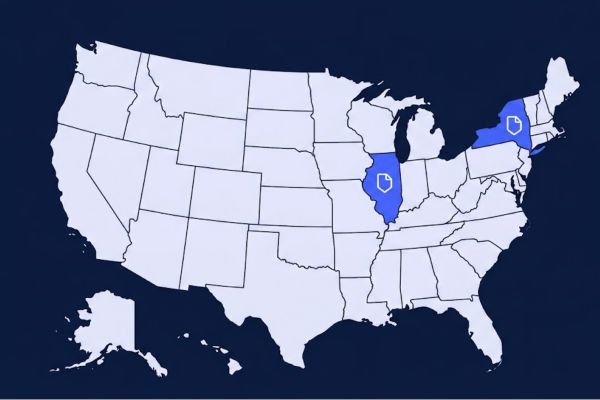
Illinois measures the totality of circumstances. A fintech that predominantly designs, controls, or operates a loan program (including the servicing of it) faces licensing exposure even when the bank is named as the originator.
The practical standard in high-scrutiny states is straightforward: if your company makes all the decisions about how loans are serviced, communicates with borrowers directly, manages delinquencies, and processes payments, you are the servicer. The licensing requirement follows the function, not the label, and this varies state by state.
Structure 3: You purchased a consumer loan portfolio
Portfolio acquisitions require a state-by-state analysis before the transaction closes, not after. Several legal issues can arise depending on whether the acquired loans are performing or delinquent.
For performing loans, the acquirer steps into a servicing role from day one. States that extend servicer licensing to loan purchasers include those using economic interest tests (Connecticut, Maine, Illinois) and those with broad definitions of "engaging in the business of" consumer lending or servicing.
For delinquent accounts, the licensing analysis may shift from servicing to debt collection. Most states with collection licensing requirements apply them once accounts are charged off or placed for collection. But the transition between the two is not always a clean line. A fintech that purchases a mixed portfolio, some performing and some delinquent, may need both a servicer authorization and a collection license.
States requiring the most attention for consumer loan servicers
The following states have explicit or effectively applied servicer licensing requirements for non-mortgage consumer loan servicers operating outside the traditional origination relationship. This is not an exhaustive list, and requirements change. Use this as a starting point for state-by-state legal analysis.
What a consumer loan servicer license application typically requires
The specifics vary by state and license type, but these are the elements you should expect to prepare for any new servicer license application.
NMLS company record. Many states manage consumer lender and servicer licenses through the Nationwide Multistate Licensing System. If your company does not have an NMLS record, creating one is the first step. Some states require direct filings outside NMLS for servicer authorizations, particularly for non-mortgage consumer loan servicer registrations. Confirm the filing path for each state before assuming NMLS submission is sufficient.
Net worth requirements. Servicer-only licenses typically have lower net worth thresholds than combined lender-servicer licenses. Requirements range from $25,000 to $250,000 depending on state and license type. Some states scale net worth requirements to portfolio size or serviced loan volume.
Surety bond. Most states require a surety bond for servicer applicants. Bond amounts for servicers are often calculated based on the volume of loans being serviced rather than originated. For example, at the time of this article, Washington requires a $30,000 electronic surety bond filed through NMLS. Other states use different calculation methods. Confirm state-specific requirements before bonding.
Background checks. All control persons, principal officers, and in some states, major shareholders require criminal background checks (which includes fingerprints) and credit reports filed through NMLS.
Policies and procedures documentation. State regulators reviewing servicer applications expect to see written policies covering: payment processing and application, borrower communication standards, complaint handling and resolution, escrow management (where applicable), loss mitigation and forbearance procedures, and fair lending, Information Security, Privacy (GLBA), Business Continuity, Vendor Management, Record Retention, Cybersecurity, Regulatory Change Management, AML/Bank Secrecy Act, Red Flags, UDAAP, and UDAP compliance.
Financial statements. Most states require audited or reviewed financial statements from the prior fiscal year. Some states accept compiled financials for servicers below certain portfolio thresholds. Some states may have their own, additional requirements, for example, Washington requires two prior years of financials for applicants that also service student loans or mortgage loans.
Corporate good standing. A servicer license application will not be accepted if your entity is not in good standing with the Secretary of State in your formation state and every state where you have registered to do business. Confirm good standing status before filing any new state applications, a recent good standing certificate will need to be uploaded in the state you are applying to.
Foreign qualification. Holding a servicer license requires being registered to do business in the license state. If your entity is not yet foreign-qualified in a target state, that filing must come before or concurrent with the license application, and the application will not be approved until the company has been approved in such state by their corporations/secretary of state to do business in the state.
Related: How Brico handles licensing applications for loan servicers
Ongoing compliance obligations after licensing
Getting licensed is the beginning of the compliance program. Maintaining a consumer loan servicer license requires ongoing operational, financial and regulatory oversight throughout the business lifecycle.. Servicers managing a multi-state portfolio face recurring obligations that compound quickly as states are added.
Annual renewals. Most servicer licenses renew annually through NMLS or direct state filing. Renewal windows, fees, and documentation requirements vary, but normally include a review and update of surety bonds, ensuring your record is up to date, and all necessary reports have been filed. A missed renewal does not just create a lapse. It can trigger deficiency notices, restrict your ability to service new loans, and loans you currently hold, and surface in secondary market due diligence.
Call reports and financial reporting. States with active servicer licensing programs typically require periodic financial reports. The frequency varies: some states require quarterly submissions, most require annual. These reports cover portfolio size, delinquency metrics, borrower complaint counts, and financial condition indicators.
Examination readiness. State examiners reviewing servicer operations look at payment application accuracy, timing of statements and notices, complaint resolution records, loss mitigation documentation, and credit bureau furnishing practices. Examination frequency depends on the state and your risk rating. California's DFPI and New York's DFS both run active examination programs for consumer finance entities.
Change of control notifications. If your company undergoes a merger, acquisition, or material change in ownership, most servicer licenses require advance notification to the state regulator. In some states, a new application is required. Failing to notify a regulator of a change of control is a separate compliance violation from the licensing status itself.
Updates to your Company Record. Any changes or updates to your company record, including but not limited to, address changes, officer/director changes, surety bond providers, business activities, etc. must be reported and many require advance change notice to the state regulators. The timing is dependent on each state and should be reviewed and considered before making any material changes that impact the company record.
The federal layer: what CFPB supervision means for consumer loan servicers
State licensing is not the only oversight framework for consumer loan servicers. Federal law creates additional obligations that apply regardless of state licensing status.
The CFPB has broad supervisory authority over nonbank entities in mortgage servicing, private student loan servicing, and payday lending regardless of company size. For general consumer installment loan servicers, the Bureau's authority depends on whether the entity qualifies as a "larger participant" in an applicable market or falls under the CFPB's risk-based supervision authority. Servicers with significant portfolio volume and consumer complaint patterns should assume they are within range of CFPB attention even if not subject to formal larger participant rules.
The federal statutes that apply most directly to consumer loan servicers:
TILA / Regulation Z requires periodic statements for closed-end loans over certain thresholds, governs payoff statement timing, and controls how rate adjustments are communicated for variable-rate products.
ECOA / Regulation B applies to adverse action decisions on loan modifications, workout agreements, and forbearance requests. If a servicer denies a borrower a loss mitigation option that constitutes a credit extension decision, ECOA notice requirements apply.
FCRA requires servicers that furnish data to consumer reporting agencies to maintain accuracy, investigate disputes within required timeframes, and have policies for handling consumer notifications about adverse credit reporting.
FDCPA covers servicers collecting on consumer loans that were in default when acquired, or servicing for a creditor other than the original lender, and subjects them to FDCPA restrictions on communication, validation notices, and collection conduct.
UDAAP prohibits unfair, deceptive, or abusive acts and practices in consumer financial services under the Consumer Financial Protection Act. State examiners test for UDAAP compliance routinely during servicer examinations, and enforcement actions against servicers frequently cite UDAAP violations alongside state licensing deficiencies.
Gramm Leach Bliley- Information Security regulations ensure companies have policies and procedures in place to protect non-public personal information and companies maintain adequate safeguards to protect data and ensure privacy protections are in place as well as disclosure when there is a breach or issue.
When do you also need a debt collection license?
Servicer licensing and debt collection licensing are related but not interchangeable. Most servicer licenses cover performing loans, meaning borrowers who are current or in early-stage delinquency. Debt collection licensing typically applies once an account is charged off or placed for third-party collection.
The practical problem is that the transition between the two is not always a clean line, and most fintechs move through both phases of a loan's lifecycle. A servicer that handles its own early-stage delinquency management through internal teams is often exempt from debt collection licensing as a first-party creditor. But once a loan is charged off and sent to a third-party collector, or once the servicer itself begins collecting on accounts it acquired in default, collection licensing requirements apply.
Several states have closed exemptions that previously allowed some servicers to operate without collection licenses.
- California's Debt Collection Licensing Act explicitly includes debt buyers.
- Illinois's Collection Agency Act explicitly covers debt buying, and a 2025 amendment (Senate Bill 2457, effective January 1, 2026) preserved that scope while adding new exemption categories. Those exemptions are narrow, though. A company licensed under Illinois's Consumer Installment Loan Act, for example, is exempt only when collecting loans it originated itself, not when it buys debt originated by someone else.
- New York's usury rules affect how debt buyers can enforce interest on charged-off accounts.
The safest posture for a fintech that both services performing loans and manages delinquent accounts is to assess both licensing tracks in every state with material borrower concentration. See Brico's guide to debt collection licensing requirements by state for the full analysis.
Servicer licensing in bank partnership models
The bank partnership licensing question for servicers is more exposed than most compliance teams appreciate, and the legal landscape shifted notably between 2023 and 2026.
When a chartered bank originates loans and a fintech manages all post-origination borrower interactions, the bank's charter does not extend preemption to the fintech's servicing activities. The bank originates; the fintech services. Those are separate functions with separate licensing triggers.
The states that have moved most aggressively to require licensing for bank-partner servicers are Connecticut, Nebraska, Maine, and Illinois. In each of these states, the relevant statute now reaches servicers based on their economic role in the loan, not their formal legal relationship with the originating bank. A fintech that holds the economic interest in receivables, controls the loan program design, and manages all borrower relationships is likely the servicer under these statutes even if the bank is named as the originator on the note.
A strong compliance framework for bank-partner servicers must map every state's requirements and confirm where servicer licensing obligations apply before launching operations. Firms that grow fast without this groundwork often face delayed partnerships, secondary market complications, or enforcement findings once regulators review the structure.
Ohio went the other direction in October 2025, with the DFI reversing earlier guidance and confirming it will not require non-bank entities compensated for arranging bank loans to obtain a Small Loan Act license. The Ohio reversal is a useful reminder that state guidance on this question is not static, and that monitoring regulatory developments in your borrower states is an ongoing obligation, not a one-time diligence exercise.
Building your servicer licensing program
Consumer loan servicer licensing is an operational compliance function that compounds as your portfolio grows and your state footprint expands. The companies that manage it well share a few practices.
Map borrower states first. Servicer licensing follows the borrower, not the servicer's home office. Your licensing obligations are determined by where your borrowers live, not where your company is incorporated. If your portfolio has significant concentration in California, Connecticut, Illinois, and Washington, those are your priority states regardless of where your operations team sits.
Separate the servicer license calendar from the origination license calendar. Many fintechs bundle servicer license renewals into origination license management, which creates a risk of the servicer obligations getting deprioritized during heavy origination-side filing periods. Renewal windows, call report deadlines, and examination cycles for servicer licenses are often on different schedules than origination licenses in the same state. Track them separately.
Do not assume your lender license covers third-party servicing. Confirm it explicitly in the statute and the license scope definition for every state where you service loans you did not originate. If the statute is ambiguous, get a legal analysis. The cost of that analysis is small relative to the cost of an examination finding that your servicing activity was unlicensed.
Build examination-ready documentation now. State examiners reviewing servicer operations expect to see payment application logs, borrower communication records, complaint tracking, and forbearance documentation. Build these audit trails as part of your operating procedures, not as a response to an examination request. Examiners also expect to see complete policies and procedures related to most federal and state regulatory requirements, especially QC, complaints, cybersecurity, information security/GLBA, TILA, ECOA, etc. Ensure you are tracking your QC process, reporting to management and documenting your process and decisions related to items that come up in compliance.
Plan for portfolio acquisitions before they close. If your growth strategy includes acquiring consumer loan portfolios, the licensing analysis needs to happen during due diligence. Confirm the servicer licensing status in every borrower state before the transaction closes. An unlicensed servicer cannot collect payments in some states, which directly affects portfolio valuation.
Brico tracks consumer loan servicer license requirements separately from origination licenses, maintains renewal calendars across all 50 states, and builds the examination audit trail that servicers need when regulators come knocking. If you are building or expanding a consumer loan servicing operation, see how Brico can help.
This article is for informational purposes only and does not constitute legal, financial, or regulatory advice. Brico is not a law firm and does not provide legal counsel. Licensing requirements vary by state and depend on your specific business model and circumstances. Consult with qualified legal counsel before making any licensing decisions or taking action based on this content.