You're launching a fintech company that will need money transmitter licenses across multiple states. Before you file your first license application, you need to answer a foundational question: where should you incorporate?
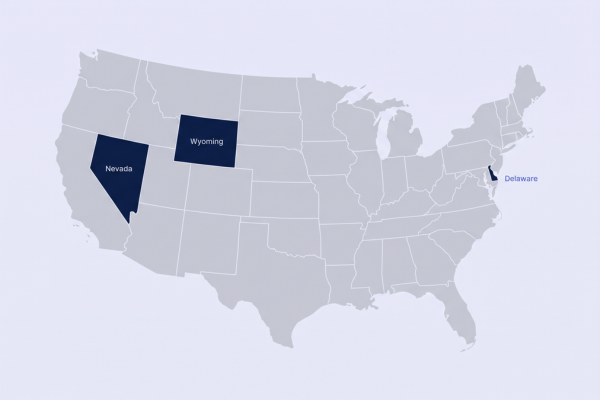
Delaware dominates tech startups: 67% of Fortune 500 companies and most VC-backed startups incorporate there. But Wyoming has surged as an alternative, especially for crypto and blockchain ventures. Nevada attracts businesses seeking privacy and asset protection. Each state offers distinct advantages, but the "best" choice depends on your funding strategy, regulatory obligations, and growth trajectory.
This guide breaks down the Delaware vs. Wyoming vs. Nevada decision specifically for fintech founders pursuing multi-state licensing.
Why Incorporation Location Matters for Fintech Companies
It's More Than Just a Filing Address
Your state of incorporation determines your legal framework and corporate governance standards, annual compliance costs and franchise taxes, investor perceptions and fundraising prospects, and regulatory relationships (you'll need good standing in this state for every MTL application).
The Foreign Qualification Factor
Here's a critical point many founders miss: if you incorporate in Delaware (or Wyoming or Nevada) but operate from California, you'll need to foreign qualify in California. You pay fees in both states.
For fintechs pursuing nationwide money transmitter licenses, this creates complexity regardless of where you incorporate. You'll be registered as a foreign entity in 40+ states anyway, each requiring annual reports and registered agents.
The incorporation decision is less about "where you'll operate" and more about legal infrastructure, investor expectations, and total cost of ownership.
Note: Many of these costs are estimates. Your business’ actual fees may vary depending on your entity type, whether or not you file applications or annual reports by mail or electronically, etc.
Delaware: The Gold Standard (With Premium Costs)
Why Delaware Dominates
Delaware hosts more than 1.9 million business entities, including 67% of Fortune 500 companies and an estimated 90% of VC-backed startups that raise Series A or later. This dominance stems from several structural advantages.
The Court of Chancery: Delaware maintains a specialized business court staffed by judges (not juries) with deep expertise in corporate law. Cases resolve faster with more predictable outcomes. When disputes arise—shareholder conflicts, M&A disagreements, fiduciary duty questions—Delaware's Chancery Court provides clear, established precedent.
The Delaware General Corporation Law (DGCL): Delaware's corporate statute is the most flexible and well-developed in the country. It's been refined over more than 100 years with continuous updates responding to business needs. Every corporate attorney in the U.S. knows the DGCL.
Investor Preference: VCs, institutional investors, and investment banks overwhelmingly prefer Delaware C-Corps. If you plan to raise institutional capital or pursue an IPO, Delaware eliminates friction. Investors won't need to evaluate unfamiliar state laws or worry about untested legal frameworks.
Ecosystem and Resources: Because so many companies incorporate in Delaware, there's an entire ecosystem built around Delaware corporations; formation services, compliance tools, legal templates, and attorney expertise all assume Delaware by default.
Delaware Costs: What You'll Actually Pay
Delaware's advantages come with premium pricing.
Estimated Formation Costs:
- Filing fee: $89 (online) or $110 (by mail)
- Registered agent: $50-$150/year
- Total year one (formation only): $140-$260
Annual Franchise Tax (The Real Cost):
Delaware imposes an annual franchise tax on all corporations. The amount depends on your calculation method:
Critical insight: Most startups authorize millions of shares (often 10 million), which would cost $75,000+ using the Authorized Shares Method. Smart founders use the Assumed Par Value Method instead, resulting in $400-$800 in franchise tax for lean startups with limited assets.
Estimated Total Annual Cost (Delaware C-Corp):
- Franchise tax: $400-$800 (using optimized method)
- Annual report filing: $50
- Registered agent: $50-$150
- Total: $500-$1,000/year
For Delaware LLCs, the estimated cost structure differs:
- Annual tax: $300 flat fee
- No annual report required
- Registered agent: $50-$150
- Total: $350-$450/year
Related: State Franchise Tax Requirements for Fintechs
Delaware's Hidden Complexity
Franchise tax calculation requires financial data (total gross assets from Schedule L of Form 1120) and share information (issued vs. authorized shares), which creates administrative overhead. Missing the March 1 deadline triggers a $200 penalty plus 1.5% monthly interest.
For fintech founders managing multi-state licensing, Delaware adds another compliance layer, but it's a layer most investors expect and most attorneys can handle in their sleep.
When Delaware Makes Sense
Delaware is the right choice if you're pursuing venture capital or planning institutional fundraising, building toward an IPO or acquisition, need maximum legal predictability for complex corporate structures, or want to eliminate investor concerns about state of incorporation.
For fintech companies with serious growth ambitions, Delaware remains the default recommendation.
Wyoming: The Challenger Brand
Wyoming's Rise
Wyoming has overtaken Delaware on a per-capita basis for new formations (378 new companies per 1,000 adults vs. Delaware's 268). What's driving this shift?
Dramatically Lower Costs: Wyoming's ongoing fees are roughly one-fifth of Delaware's. For bootstrapped founders or companies prioritizing cash conservation, this matters.
Blockchain and Crypto Leadership: Wyoming passed the most progressive cryptocurrency and digital asset laws in the country, including the Special Purpose Depository Institution (SPDI) framework that enables crypto-native banks. Companies like Kraken chose Wyoming for regulatory clarity on digital assets.
Privacy Protections: Wyoming offers stronger privacy protections for LLC members than most states, though this advantage is diminishing as federal beneficial ownership reporting requirements (Corporate Transparency Act) apply nationwide.
No Franchise Tax: Wyoming imposes no franchise tax, only an annual license tax based on company assets.
Wyoming Costs: What You'll Actually Pay
Estimated Formation Costs:
- Filing fee: $100
- Registered agent: $50-$125/year
- Total year one: $150-$225
Estimated Annual Costs:
- Annual report: $60 minimum (increases with Wyoming-based assets)
- Registered agent: $50-$125
- Total: $110-$185/year
That's roughly one-fifth to one-tenth of Delaware's ongoing costs.
Wyoming's Tradeoffs
Less Established Legal Framework: Wyoming established its Court of Chancery equivalent in 2021: it's brand new compared to Delaware's 200+ years of precedent. Predicting how Wyoming courts will rule on novel corporate issues involves more uncertainty.
Investor Perception: Some VCs and institutional investors remain skeptical of non-Delaware entities. They're comfortable with Delaware's legal framework and don't want to evaluate unfamiliar state laws. This perception is changing, especially in the crypto/blockchain space, but it's not gone.
Smaller Ecosystem: Fewer tools, templates, and standard practices exist for Wyoming corporations compared to Delaware. You may encounter attorneys less familiar with Wyoming corporate law.
Fraud Concerns: Wyoming's low costs and minimal oversight have attracted some bad actors, creating an adverse selection problem. Sheridan, Wyoming (population <20,000) is listed as the business address for 120,000+ LLCs: many appear to be shell companies. This reputation issue could invite closer regulatory scrutiny.
When Wyoming Makes Sense
Wyoming is the right choice if you're bootstrapping or prioritizing low ongoing costs, focused on cryptocurrency, blockchain, or Web3, comfortable with less established legal precedent, or planning to raise from crypto-native VCs who embrace Wyoming entities.
For fintech companies in the digital asset space, Wyoming offers regulatory advantages that may outweigh Delaware's institutional preference.
Nevada: The Privacy Play
Nevada's Positioning
Nevada markets itself as the privacy-friendly, tax-advantaged alternative to Delaware. It attracts businesses through no corporate income tax, no franchise tax, strong director liability protections, and enhanced privacy for shareholders and officers.
Nevada Costs: What You'll Actually Pay
Estimated Formation Costs:
- Filing fee: $425+ (varies by entity type)
- Business license: Required
- Registered agent: $100-$200/year
- Total year one: $525-$625+
Estimated Annual Costs:
- Annual list filing: $150-$500
- Business license renewal: Varies
- Registered agent: $100-$200
- Total: $250-$700/year
Nevada's initial filing fees are the highest of the three states, though ongoing costs fall between Wyoming and Delaware.
Nevada's Limitations
Lack of Specialized Business Courts: Nevada doesn't have a Chancery Court equivalent. Business disputes go through general courts with judges who may lack deep corporate law expertise. This creates more uncertainty and longer resolution times.
Investor Skepticism: Like Wyoming, some investors view Nevada less favorably than Delaware for serious startups. Nevada's reputation for attracting tax-motivated businesses rather than growth-focused companies can work against fundraising.
Limited Legal Precedent: Nevada's corporate caselaw is less developed than Delaware's, creating uncertainty about how courts will handle novel issues.
Overhead Complexity: Nevada requires more administrative maintenance than Wyoming (business licenses, more complex reporting) without offering Delaware's legal infrastructure advantages.
When Nevada Makes Sense
Nevada works for established businesses seeking privacy and asset protection, companies with significant director liability concerns, or businesses with no plans for institutional fundraising or exit.
For most fintech startups, Nevada offers the weakest value proposition of the three states—higher costs than Wyoming without Delaware's investor appeal.
The Fintech-Specific Considerations
Multi-State Licensing Reality
Money transmitter licenses require good standing in your state of formation and every state where you're registered as a foreign entity. Once you foreign qualify in 40+ states, your incorporation location becomes just one state among many.
Related: How Much Do MTLs Cost?
The estimated calculation changes:
For a company operating only in one state:
- Delaware costs $500-$1,000/year
- Wyoming costs $110-$185/year
- Savings: $390-$815/year
For a company with MTLs in 50 states:
- Delaware base: $500-$1,000
- Wyoming base: $110-$185
- Both require foreign qualification in 49 other states: ~$8,000-$15,000/year
- Savings: $390-$815 out of $8,500-$15,500 total (2.5-5.3%)
The incorporation location premium becomes a smaller percentage of total corporate compliance costs.
Regulatory Perception
State banking regulators are familiar with Delaware corporations—it's the default expectation. Wyoming and Nevada entities may prompt additional questions during licensing examinations, though this shouldn't disqualify you if you're otherwise compliant.
Some states' MTL applications explicitly request your state of incorporation and may ask for good standing certificates from that state throughout your licensing lifecycle.
Franchise Tax and Capital Structure
Delaware's franchise tax creates an interesting dynamic for VC-backed fintechs. As you raise funding and your gross assets increase, your franchise tax liability rises (under the Assumed Par Value Method). Companies with $10M+ in assets may pay $2,000-$5,000 annually.
Wyoming's asset-based annual report fee also scales, but typically remains well below Delaware's franchise tax.
For companies anticipating significant venture funding, this ongoing cost difference compounds over time.
The Fundraising Factor
Investor Expectations by Stage
Pre-seed/Seed: Investors care more about product and traction than state of incorporation. Wyoming is acceptable, even advantageous if you're in crypto/Web3.
Series A and Beyond: Institutional investors strongly prefer Delaware C-Corps. Some VCs will require Delaware re-incorporation before investing.
Crypto-Specific Funds: Crypto-native VCs are comfortable with Wyoming entities and may even prefer them for regulatory clarity on digital assets.
The Re-Incorporation Option
If you start in Wyoming but later pursue traditional VC funding, you can re-incorporate in Delaware. This process (called a "redomestication" or "domestication") involves legal fees ($5,000-$15,000), administrative complexity, and potential tax implications.
Many founders who plan to raise institutional capital eventually just start in Delaware to avoid this friction later.
Head-to-Head Comparison
Decision Framework for Fintech Founders
Start with these questions:
1. What's your funding strategy?
- Traditional VC → Delaware
- Bootstrapped or revenue-funded → Wyoming
- Crypto-native VCs → Wyoming or Delaware
- No external funding plans → Wyoming or home state
2. What's your business model?
- Blockchain/crypto/Web3 → Wyoming
- Traditional fintech (payments, lending, remittances) → Delaware
- Privacy-focused, high-net-worth clients → Nevada
3. What's your timeline to institutional funding?
- <12 months → Delaware (avoid re-incorporation friction)
- 18+ months or uncertain → Wyoming (can re-incorporate later if needed)
4. How cost-sensitive are you?
- Minimal runway, watching every dollar → Wyoming
- Well-funded, costs aren't primary concern → Delaware
5. Do you need crypto regulatory clarity?
- Yes, operating in digital assets → Wyoming
- No, traditional financial services → Delaware
Special Considerations: Your Home State
Before choosing Delaware, Wyoming, or Nevada, consider one more option: your home state.
When Home State Makes Sense
If you're a single-state fintech (only need one or two MTLs) with no plans for institutional funding and want to minimize complexity, home state incorporation avoids foreign qualification fees.
However, most fintechs pursuing multi-state licensing will foreign qualify in dozens of states anyway, eliminating the "avoid foreign qualification" advantage.
The Foreign Qualification Math
Incorporating in Delaware but operating from California:
- Delaware formation + annual costs: $500-$1,000
- California foreign qualification: ~$100 initial + $25 annual
- Estimated Total: $600-$1,100/year
Incorporating in California:
- California formation + annual costs: ~$900/year (includes $800 franchise tax)
- No foreign qualification needed (in California)
- Estimated Total: $900/year
For California-based companies, Delaware actually costs less than incorporating in-state—once you factor in California's $800 minimum franchise tax.
The home state calculation varies significantly by state. Low-cost states (Wyoming, Colorado, Michigan) make home state incorporation attractive. High-cost states (California, Illinois, New York) may actually be more expensive than Delaware.
Common Myths Debunked
Myth: "I need to be physically located in Delaware to incorporate there."
False. You can incorporate in Delaware from anywhere in the world with no physical presence required. You just need a Delaware registered agent.
Myth: "Delaware is only for big corporations."
False. Delaware works for companies of all sizes. The franchise tax can be optimized for startups using the Assumed Par Value Method ($400 minimum vs. $75,000+ if calculated incorrectly).
Myth: "Wyoming corporations can't raise VC funding."
False. Wyoming corporations can raise funding, but some VCs may require re-incorporation to Delaware as a condition of investment. Crypto-native VCs often prefer Wyoming.
Myth: "Incorporating in Nevada avoids all taxes."
False. Nevada has no corporate income tax or franchise tax, but you'll still pay federal taxes. If you conduct business in other states, you'll owe taxes in those states based on nexus rules.
Myth: "Your incorporation state determines where you pay income tax."
False. You pay income tax based on where you conduct business (economic nexus), not where you're incorporated. A Delaware corporation doing business in California pays California income tax.
The Verdict: What Most Fintechs Should Do
For Traditional Fintech Startups (Payments, Lending, Remittances)
Delaware remains the safest choice if you're pursuing VC funding now or within 18 months, planning for eventual exit (acquisition or IPO), want to eliminate any investor friction, or prioritize legal predictability over cost savings.
The annual cost premium ($300-$800 vs. Wyoming) is small relative to your overall budget and completely justifiable to investors.
For Crypto/Blockchain/Web3 Companies
Wyoming offers meaningful advantages if you're building on blockchain or working with digital assets, targeting crypto-native investors who embrace Wyoming entities, bootstrapping or revenue-funded with cost sensitivity, or comfortable with less established legal precedent.
Wyoming's regulatory clarity on crypto often outweighs Delaware's institutional preference in this specific vertical.
For Most Small Fintechs
Wyoming wins on pure cost-benefit analysis for companies that are bootstrapped or early-stage with limited runway, won't seek institutional VC funding in the near term, operate in crypto/blockchain space, or prioritize low ongoing costs over investor perception.
Re-incorporation to Delaware remains an option if circumstances change.
Implementation: Next Steps
Once you've chosen your state:
- Engage legal counsel experienced in fintech and corporate formation
- Form your entity through the state's filing office or a formation service
- Obtain an EIN from the IRS
- Designate a registered agent in your formation state
- Prepare corporate governance documents (bylaws, operating agreement, etc.)
- Plan for foreign qualification in states where you'll conduct business or seek licenses
Related: Secretary of State Registration Costs: Complete Guide
Timeline Expectations
- Delaware formation: 1-2 business days
- Wyoming formation: 1-2 business days
- Nevada formation: 3-5 business days
- Foreign qualification (per state): 1-4 weeks
These timelines may vary depending on how you file (online or by mail) or if you pick an expedited formation option. Factor incorporation into your overall licensing timeline, as you'll need good standing certificates from your formation state before filing MTL applications.
Build Your Corporate Foundation Strategically
Your incorporation decision creates the legal foundation for everything that follows—fundraising, licensing, governance, and eventual exit. Get it right from the beginning.
For most fintech companies with serious growth ambitions, Delaware remains the gold standard. The cost premium is justifiable, investor friction disappears, and legal infrastructure is unmatched.
For crypto/blockchain ventures and cost-conscious bootstrappers, Wyoming offers compelling advantages that may outweigh Delaware's institutional preference.
Nevada works for specific use cases but rarely offers the best overall value for fintech startups.
Ready to navigate multi-state licensing after incorporation? Contact Brico to learn how we help fintech companies manage Secretary of State registrations, money transmitter licenses, and ongoing compliance across all 50 states.