
.png)
Most compliance teams first got serious about the Money Transmission Modernization Act, (MTMA or Model Act) when their largest-volume states adopted it. That was a reasonable approach in 2022. It isn't anymore.
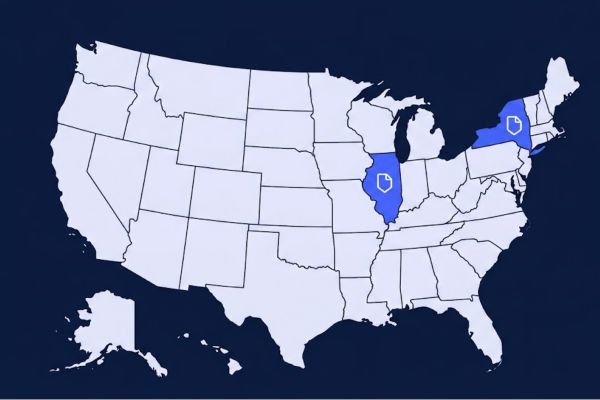
As of late 2025, more than 42 states and D.C. have enacted the MTMA in full or in part — and ten of those states made the move in 2024 and 2025 alone. For example, Illinois went live January 1, 2026,Virginia's effective date will be July 1, 2026, and Massachusetts completed a full licensing transition in early 2026. If your compliance program hasn't been re-audited against the MTMA in the past 18 months, there's a good chance it has gaps you haven't found yet.
This MTMA compliance checklist covers the six areas that most often produce examination findings: state footprint mapping, licensing definitions, capital requirements, virtual currency treatment, NMLS filings, and ongoing monitoring. It's written for compliance teams already operating at scale — not as an introduction to what the MTMA is, but as a practical audit framework for where programs break down.
The MTMA Compliance Checklist: 6 Areas to Audit Right Now
The sections below are ordered by sequence, not by importance. You can't assess your capital position until you know which states' MTMA requirements apply to you. You can't confirm your NMLS filings are current until you know what the current requirements are. Work through them in order, even if some feel like a formality.
1. Map Your State Footprint Against MTMA Adoption
Before any other audit step, you need a current, accurate picture of which states you hold licenses in, which of those states have adopted MTMA, and what version of MTMA each state enacted.
That last part matters more than most teams realize. MTMA adoption isn't uniform. Some states enacted the full model act. Others adopted it selectively, excluding specific provisions — most notably the virtual currency provisions. Colorado, Mississippi, and Virginia all adopted MTMA but excluded the optional VC provisions from their versions of the law. That changes what compliance looks like in those states for crypto-adjacent products.
What to check:
- Pull a current list of every state where you hold a money transmitter license or actively conduct transmission activity.
- Cross-reference against the current MTMA adoption list, noting full vs. partial adoption.
- For each MTMA-adopted state, confirm whether VC provisions were included or excluded.
- Flag states with 2025–2026 effective dates (Illinois, Virginia, Massachusetts, Nebraska, Colorado, Mississippi) for a targeted re-audit — these are the highest-probability gaps.
- Confirm whether each state issued transition guidance through NMLS for existing licensees.
A state footprint map that was accurate in 2023 is not accurate today. The pace of adoption over the past two years means many licensing inventories are at least a few states behind.
2. Review Licensing Definitions and Exemptions Under MTMA
One of MTMA's core goals was standardizing the definition of "money transmission" across states — removing the technical variations that created licensing uncertainty for companies operating nationally. It largely succeeded. But standardization also means some companies that were operating under informal safe harbors or older state-specific interpretations are now squarely inside MTMA's scope.
The flip side is also true. MTMA codified exemptions that didn't exist under many pre-MTMA state laws, including exemptions for payroll processors and agent-of-the-payee arrangements. Colorado, for example, explicitly codified both when it adopted MTMA in August 2025. If your company processes payroll or operates as an agent of the payee, you may now qualify for a licensing exemption in MTMA-adopted states where you previously held a license.
What to check:
- Review your current business activities against MTMA's definition of money transmission in each adopted state — confirm you still require licensure, or document your exemption analysis in writing if an exemption applies.
- If relying on an agent-of-the-payee or payroll processor exemption, verify that the specific MTMA-adopted state included those exemptions in its enacted version.
- Confirm that authorized delegates and agents operating under your license are properly registered under updated MTMA-aligned frameworks, since delegate registration requirements changed in several states at adoption.
- Document exemption determinations. In an examination, "we looked at it and didn't think we needed a license" is not a defensible position without a written legal analysis.
3. Audit Capital: Net Worth, Surety Bonds, and Permissible Investments
This is the section where examination findings originate. Capital deficiencies, lapsed bonds, and investments that don't qualify as permissible under MTMA are among the most common items regulators flag: and they're the ones most likely to trigger corrective action plans or license suspension risk.
Tangible Net Worth
MTMA's Section 10.01 sets a minimum TNW of $100,000, scaled against total assets: 3% of total assets for the first $100 million, 2% for assets between $100 million and $1 billion, and 0.5% above $1 billion. Intangible assets are excluded from the calculation.
In June 2025, CSBS issued advisory guidance clarifying how virtual currency holdings should be treated in the TNW calculation. Rather than treating VC as intangible assets — which would exclude them from the calculation entirely — the guidance applies tiered asset-based percentages to determine their contribution to TNW. This applies in MTMA-adopted states regardless of whether those states included the VC provisions in their enacted versions.
What to check:
- Pull your most recent balance sheet and run the TNW calculation against MTMA's scaling formula for each adopted state.
- If your company holds virtual currency, confirm your accounting team is applying the June 2025 CSBS methodology, not treating VC as intangibles.
- Note that some states set TNW floors above the MTMA minimum. Colorado raised its minimum from $50,000 to $100,000 when MTMA took effect there in August 2025. Verify the floor in each operating state.
Surety Bonds
MTMA standardized bond minimums but preserved state-level flexibility on form, beneficiary language, and cancellation terms. The practical implication: a surety bond that satisfied pre-MTMA requirements in a given state may no longer meet the post-MTMA standard — in either direction. Colorado's adoption, for example, reduced the minimum surety bond amount from $1,000,000 to $250,000 under MTMA.
MTMA also encourages use of the Electronic Surety Bond (ESB) service in NMLS to minimize administrative burden. In practice, this means paper bonds and outdated bond records in NMLS are likely to draw examination attention in adopted states.
What to check:
- Confirm surety bond amounts in each MTMA-adopted state reflect current requirements, accounting for any changes at adoption.
- Verify ESB filings in NMLS are current and match active bond amounts — mismatches between NMLS records and actual bond coverage are a common examination finding.
- If your bond underwriter wasn't notified of MTMA adoption in specific states, contact them now. Bond riders may be needed to reflect updated state-specific requirements.
Permissible Investments
Review your current investment schedule against MTMA's permissible investment categories. Any investments acquired or restructured since your last state examination that fall outside the MTMA-approved list need to be flagged and resolved before your next exam.
Related: How much do MTLs cost?
4. Assess Virtual Currency Activity Under MTMA
MTMA's treatment of virtual currency is the compliance area with the most operational variability — and the most room for gaps in programs that were built before the current round of adoptions.
Two separate questions need to be answered independently for each state where your company operates:
In states that included MTMA's virtual currency provisions: Does your company's crypto-related activity — wallet services, digital asset transmission, stablecoin transfers — fall within MTMA's definition of money transmission in that state? If so, is it licensed? Iowa, for example, adopted MTMA with VC provisions intact in 2023 and explicitly treats virtual currency as "monetary value" requiring licensure. Companies that began crypto products after Iowa's MTMA adoption and didn't revisit their licensing footprint may be operating without proper coverage there.
In states that excluded the VC provisions (Colorado, Mississippi, Virginia): What state-specific framework applies to virtual currency activity, and is your company compliant with that framework? Exclusion of MTMA's VC provisions doesn't mean crypto activity is unregulated in those states — it means a different regulatory framework governs it.
A third question applies everywhere: the June 2025 CSBS guidance on VC in TNW calculations applies regardless of whether a state adopted the VC provisions. If your company holds virtual currency on its balance sheet, the TNW treatment discussed in the capital section above applies to you whether you're in Iowa (VC provisions included) or Colorado (VC provisions excluded).
Stablecoin issuers should also note that the June 2025 CSBS guidance explicitly excludes fiat-backed payment stablecoins from its VC treatment methodology. The rules governing stablecoin TNW treatment remain unsettled in most states.
5. Update NMLS Filings and Transition Licensing Records
NMLS is the operational infrastructure underlying MTMA compliance. When states adopt MTMA, they often retire old license types and create new ones. Existing licensees have to actively transition their records to stay in good standing.
Massachusetts is the clearest recent example. After updating its statutory framework in 2024, the state began requiring existing Foreign Transmittal Agency licensees to submit a transition request through NMLS beginning November 2025. No money transmitter licenses were issued before January 1, 2026, and new applicants file by July 1, 2026 to continue conducting business while applications are pending. The NMLS transition checklist for Massachusetts differs from prior renewal requirements — it's not a standard renewal with different branding. Companies that treated it as a routine filing likely missed requirements.
What to check:
- Pull NMLS license status for every MTMA-adopted state. Confirm no license has lapsed or expired during a state transition window — administrative oversights during transitions are a known source of examination findings.
- Verify ESB records in NMLS are current and match active bond amounts (this overlaps with the surety bond check above, but NMLS-level accuracy is a separate verification step).
- Check NMLS Call Report filing status. MTMA-adopted states often update their Call Report templates at adoption — if you're filing against an old template, the data may not satisfy current requirements.
- Confirm authorized delegate registrations are filed under new license structures where applicable. Pre-MTMA blanket delegate filings don't automatically carry over in all states.
If your company moved quickly to expand into states that recently adopted MTMA, the licensing filings may have been completed correctly but the NMLS records may not reflect the current state of the license. That discrepancy matters when examiners pull your records.
6. Establish Ongoing MTMA Monitoring
A compliance program that was complete at the end of 2024 has gaps today. That's not a criticism — it's a structural reality of MTMA compliance in 2025–2026. The Model Act is still spreading. CSBS is actively issuing advisory guidance. Individual states continue fine-tuning provisions post-adoption.
One-time audits don't hold. What they need to be replaced with is an operational monitoring structure.
What to build:
- Ownership: Assign a named person on the compliance team responsibility for tracking MTMA legislative and guidance updates by state. Not "the team" — a specific person.
- Cadence: Quarterly review of the state adoption map against current licensing footprint. The frequency feels like overkill until a state you're operating in adopts MTMA between your reviews.
- CSBS guidance alerts: Subscribe to CSBS advisory guidance publications. New guidance should be flagged for legal review within 30 days of issuance — the June 2025 VC guidance is a good test case for whether your current process would have caught it in time.
- Effective date calendar: MTMA effective dates need to be in your licensing calendar with lead time built in — not just the date itself. Virginia's July 1, 2026 effective date, for example, should have compliance preparation work assigned well before that date.
- Annual program review: Include MTMA provision changes in your annual compliance program review. If your annual review doesn't have a section for state-level statutory changes, add one.
Tracking 42+ states' MTMA timelines and guidance changes manually is where compliance programs fall behind. What starts as a quarterly spreadsheet update turns into a six-month lag, which turns into examination findings.
What Changes for Fintechs Already Licensed Pre-MTMA
A common assumption: "We already have a license in this state. We're fine." In MTMA-adopted states, that assumption needs to be tested, not taken for granted.
When a state adopts MTMA, it doesn't automatically bring existing licensees into compliance with the new framework. It changes the law that governs your license. Depending on the state, that can mean:
Capital thresholds changed. Colorado's MTMA adoption raised the minimum net worth from $50,000 to $100,000. A company that met Colorado's pre-MTMA capital requirements without headroom may now be deficient.
Bond requirements changed. Colorado's MTMA adoption simultaneously reduced the minimum surety bond from $1,000,000 to $250,000. That change runs in the favorable direction, but it still requires updated bond documentation and NMLS filings to reflect it. Carrying a $1M bond where $250K is now the floor isn't a compliance failure — but failing to update your NMLS records to match is.
License types changed. Massachusetts replaced its Foreign Transmittal Agency license with a new Money Transmitter License structure. Existing licensees had a transition window. Companies that didn't actively manage that transition may have an outdated license type reflected in their NMLS records even if their underlying operations are compliant.
The through-line: MTMA adoption is an event that requires a re-audit of your existing licenses in the affected state — not just a note in the compliance log.
The Compliance Gaps Most Fintechs Miss
Based on what typically surfaces in MTMA compliance reviews, these four gaps appear more often than others:
Virtual currency in TNW calculations is treated as intangibles. The June 2025 CSBS guidance changed the methodology. Companies that built their TNW calculations before June 2025 and haven't revisited them are likely calculating the number incorrectly.
State maps not updated since the 2024–2025 adoption wave. Ten states adopted MTMA in 2024–2025. Companies that reviewed their footprint in 2023 or early 2024 have an unknown number of newly-adopted states in their operating footprint that they haven't audited against MTMA requirements.
ESB filings in NMLS not transitioned from legacy paper bonds. MTMA encourages ESB use, and regulators in adopted states increasingly expect it. Old surety bond records that haven't been converted to ESB format draw examiner attention.
Delegate registration gaps. MTMA changed authorized delegate registration requirements in several states. Companies that registered delegates under pre-MTMA blanket filings and haven't verified coverage under the new frameworks may have unregistered delegates operating in MTMA-adopted states.
None of these are obscure edge cases. They're the predictable results of a compliance program that was built correctly for the regulatory environment two years ago and hasn't been fully updated since.
Conclusion
The MTMA compliance checklist above isn't a one-time project. As adoption continues—and Alaska, Nebraska, and others continue considering the model act—the number of states where MTMA governs your licenses will likely grow. The prudential standards will be updated through CSBS advisory guidance. Individual states will continue fine-tuning provisions after adoption.
The compliance teams that are ahead of this aren't doing more work. They're doing the same audit work against a current and accurate picture of the regulatory landscape, with monitoring processes that surface changes before they become findings.
Brico helps compliance teams manage money transmitter licenses and MTMA requirements across all 50 states, tracking capital thresholds, NMLS filing deadlines, and effective date changes as they happen, without the spreadsheets. See how it works →
Last updated: May 2026. Regulatory requirements change frequently. This post reflects MTMA adoption and guidance as of the publication date. Verify current state-specific requirements before making compliance decisions.